“You see how the corn leaves curl in on themselves? That’s how you know that they’re not getting enough water.” RAFI’s Just Foods Director, Kelli Dale, walks between the rows with Farm Services Director, Tee Turner, pointing at knee-high stalks swaying in the breeze.
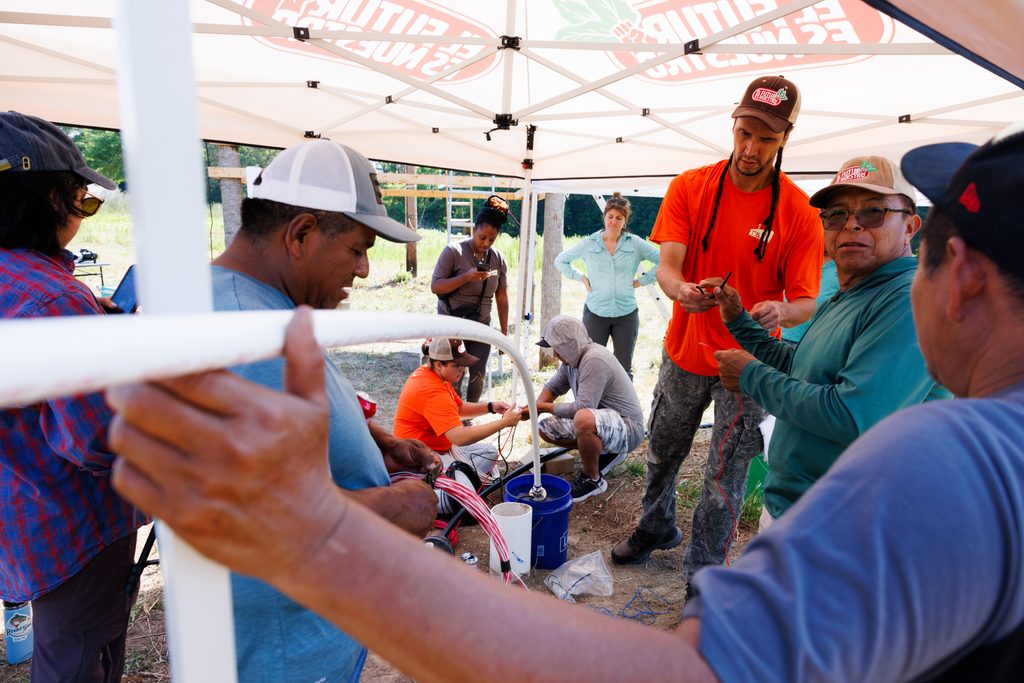
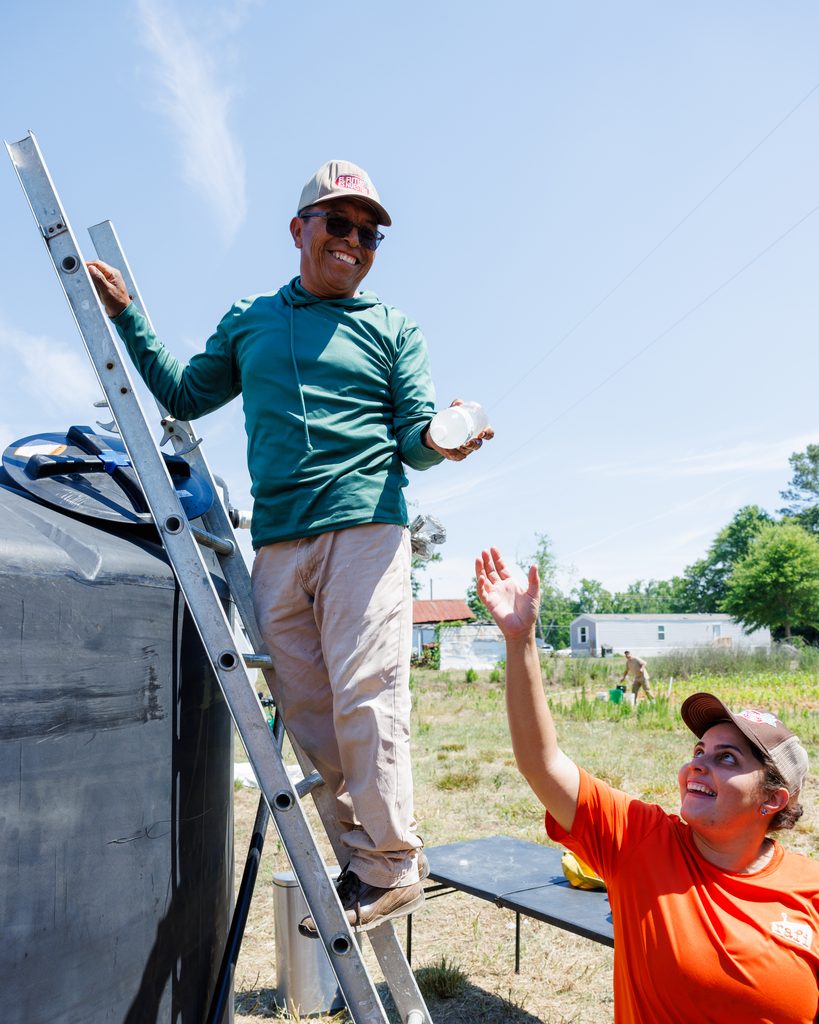
It’s 86 degrees in Spring Hope, North Carolina, and with full sun beating down on parched, tawny soil, it’s not surprising that these 11 rows of corn might be dehydrated. A stone’s throw away, RAFI staff and El Futuro Es Nuestro farmworkers huddle under the shade of a tent and a timber structure erected specifically to hold three solar panels, already sucking up sunlight. A 2,500-gallon cistern looms next to our shade points, pitch black and slowly filling with water. Over the course of this June weekend, farmers hailing from all parts of the Latin diaspora gather to install a solar pump and restore access to a crucial element of a farm’s viability: water.
Fello Pérez and Milexa Polanco are Boricua farmers who live by the phrase “metiendole caña,” or “putting in the work.” Both are RAFI Technical Assistance providers based in Puerto Rico, where they first piloted the solar pump installation project. This project may now benefit North Carolina farmers.
As with much innovation, solar pumps arose to meet a need. Pérez emphasizes the need for energy that is efficient and independent of the island’s existing, inefficient public infrastructure: “The other models we have in Puerto Rico work with AC energy, so they tend to be tied to the energy that goes to the house and comes directly from the public energy system. That is more costly, and it drains a lot of energy. And alternative pumps are so expensive and not widely available.”
A public-private partnership between Luma Energy and the Puerto Rico Electric Power Authority (PREPA) is responsible for power distribution in Puerto Rico, and both entities are notorious for widespread, frequent blackouts that can last weeks. Those blackouts don’t come cheap. In an open letter signed by over 50 Puerto Rican organizations and legal, energy, and finance experts, the authors cited average energy rates of over 28 cents per kilowatt-hour, more than double the mainland U.S. average. Not to mention that the island’s electric grid relies on expensive imported fossil fuels that account for 95% of its energy generation. Considering that, according to the U.S. Census Bureau, the median household income in Puerto Rico is $27,213 (compared to the mainland U.S. median income of $81,604), Pérez’s concerns regarding the efficiency of publicly available energy become clearer.
Similarly, North Carolina is no stranger to inefficient, expensive energy systems. Hurricane Helene caused 4.7 million power outages across the Southeast U.S., revealing an urgent need for independent energy sources as a central component of disaster resilience.
The majority of those outages occurred within Duke Energy’s power grid, totaling 1.63 million customers without power across six states. In 2025, Duke Energy unveiled its updated Carolinas Resource Plan, a long-range plan to replace solar energy with more natural gas plants and nuclear reactors. Duke assured customers that rate increases would average 2.1% annually over the course of the ten-year project.
As of 2026, Duke Energy is seeking to hike its rates by 13% in 2027 alone. Because electricity is an essential utility, companies like Duke Energy that can scale their operations become the biggest fish in a small pond, driving out energy companies that might compete with their price. Regulatory bodies like the NC Utilities Commission are meant to keep energy monopolies in check, but they rely on the formulas Duke Energy uses to set electricity rates — formulas that allow the company to earn a fixed percentage profit on its capital investment.
While Duke Energy’s 2025 Carolinas Resource Plan continues to add solar, it also calls for substantial new natural-gas generation and further development of nuclear power. Duke Energy’s own research shows that solar would save households about $84 per year by 2035. However, Duke Energy also self-imposes a 1,200-megawatt (MW) limit on the amount of solar it will build annually over 25 years. This limit pales in comparison to the exponential growth of solar in states like Florida, which has added several thousand megawatts of solar in a single year. Because Duke earns returns on approved capital investments, the current utility model can reward building expensive infrastructure rather than choosing the lowest-cost option for customers.
In Puerto Rico, more and more households are transitioning to rooftop solar power to escape a failing grid system. A challenge to making this transition, however, is accessing the material necessary to build out this alternative energy system. Pérez and Polanco remark on this challenge as they see it emerge among the farmers they work with.
“A farmer came to our solar pump workshop bringing a pump that he bought from a U.S. supplier. It was the same pump we use, with a different label on it,” Pérez says, shaking his head. Polanco continues: “But it was five times the cost of what we paid for solar pumps. It was like $5,000. We almost passed out. He was able to get a subsidy on it, but it’s not cost-effective for the farmer.”
Imports heavily impact the island’s economy, and legislation like the Jones Act burdens that economy by creating artificially higher prices. As a result, the price and availability of inputs like equipment, fertilizer, and, you guessed it, solar pumps, make access extremely restrictive for farmers. At a time when Boricua farmers find themselves in an unprecedented drought on an island that has faced severe water shortages, access to water that is both cost-efficient and energy-efficient becomes the difference between a farm that survives and a farm that doesn’t.
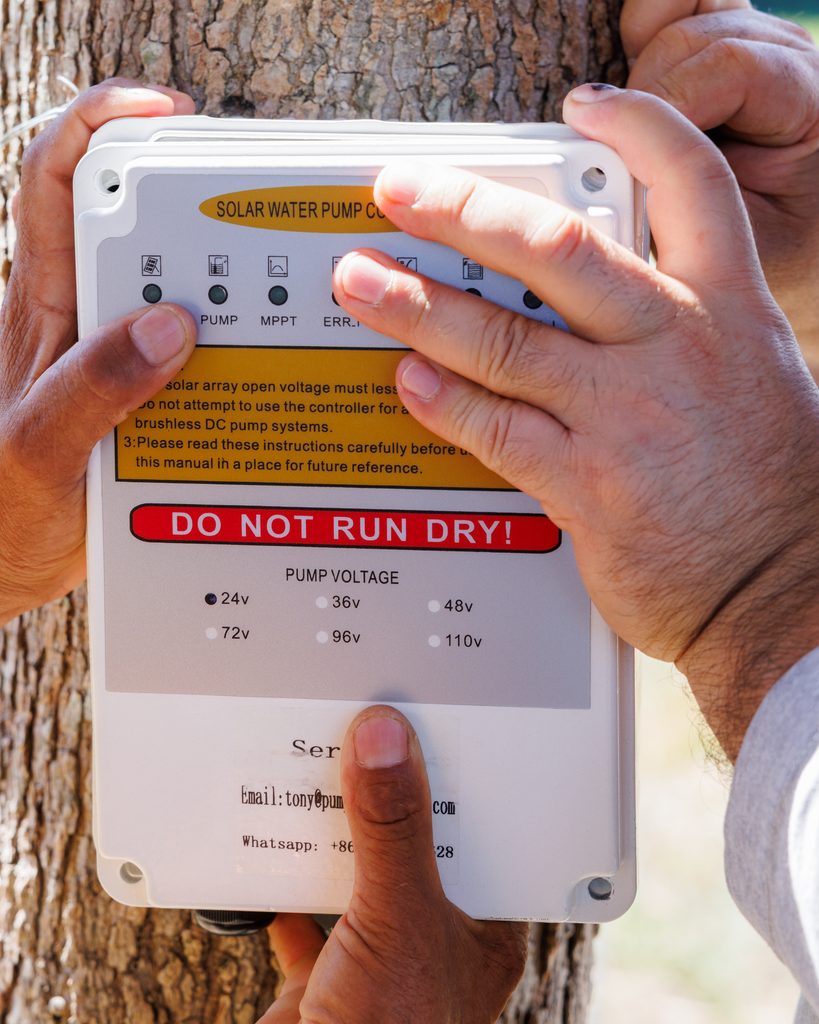
Pérez and Polanco have managed to address this challenge in just about the most creative, Latine way possible. They know a guy who knows a guy. Working their connections across the island and across the world, they manage to source solar pumps at a fraction of the cost, straight from the manufacturer. Of course, they don’t come assembled and ready for use straight out of the package. Pérez and Polanco have fashioned themselves into jacks-of-all-trades, learning to be electricians, plumbers, and engineers. They have been developing this solar pump project on a purely volunteer basis since before they joined RAFI. Now, with some organizational support, their program is in high demand across the island, and they have led several solar pump installation seminars to teach farmers how to use this technology.
“Something that Fello and I do well is think outside of the box. We think outside of the box and put in the work to make our ideas a reality. Fello is an established farmer, and I’m just starting out as a farmer, and we both know that if we are not thinking creatively to tackle the challenges we’re facing, we won’t make it,” says Polanco.
Polanco’s perspective is shared by El Futuro Es Nuestro. When this group of organizers and farmworkers purchased land to start their own farm, they, too, were thinking outside the box about land ownership. No stranger to dangerous working conditions, El Futuro Es Nuestro actively campaigns on behalf of the farmworker community for better working conditions that prioritize their safety and dignity. Their soon-to-be cooperatively owned farm, El Jornalero (The Laborer), is a pathway to economic empowerment and community built by and for farmworkers. When RAFI learned that the farm’s well had not functioned since 2019 and El Jornalero needed a cost- and energy-efficient pump system, a lightbulb went off.
On the day of the solar pump installation in North Carolina, RAFI staff from all different disciplines arrive to support the project. Leading the charge, of course, are Pérez and Polanco, who gracefully field questions on logistics, engineering, and efficiency across two languages. When one farmer asks why they shouldn’t get a gas pump with a lower upfront cost, Pérez explains how their upkeep and fuel requirements make them a more expensive choice in the long run. When irrigation costs farmers up to $68 per acre in energy and maintenance, alternative energy sources like solar can mitigate those costs more efficiently than traditional, fossil-fueled pumps. After adding together the solar panels, wiring, pump, cistern, piping, panel structure, and installation, the cost came to about $5,500 for a system that would last at least 10 years and, with care, even longer. Another farmer shares how they had been relying on neighbors for water, carrying it over in buckets to irrigate.
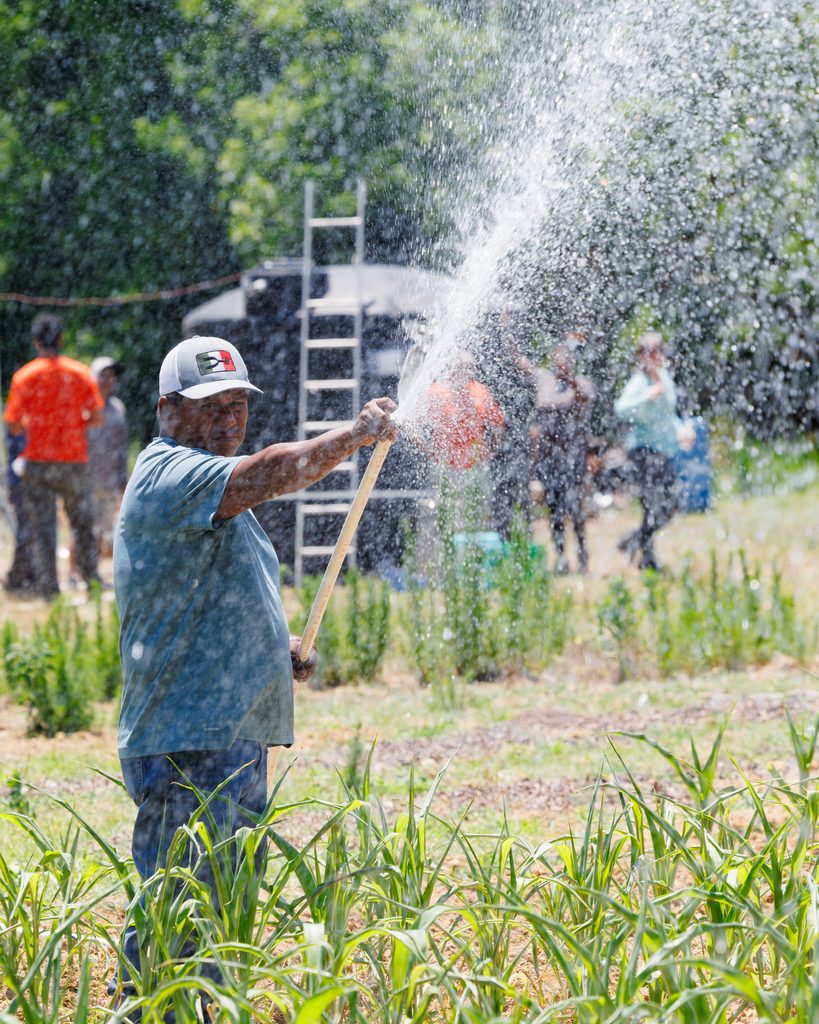
When water finally gushes through the pump attached to the cistern that had been filling for two hours, the cheers can be heard from the road. One of the farmers, Raul, takes up a PVC pipe running from the pump and sprays long arcs of water over the parched corn.
As the installation winds down, Leticia Zavala, co-coordinator of El Futuro Es Nuestro, translates for her fellow Jornaleros, expressing just how much this solar pump means to the farm. “Now that we know how we are going to irrigate, we can focus on cultivating this land, planting out more crops, and even building housing for our workers.”
As challenges in farming continue to revolve around energy monopolies, input and infrastructure costs, and climate instability, empowering farmers to create their own systems will require support from all corners of the country.
Pérez sums it up well, saying, “To me, it’s a matter of evolving. And what Puerto Rico shows us is that the challenges farmers are facing do not exist in isolation. And farmers in the states are not exempt from those challenges. This is what we’re seeing in North Carolina, too.”
Melanie Canales is the Challenging Corporate Power Project Manager at RAFI. Her years of experience in narrative development and working on farms have yielded a fierce commitment to cultivating a just and equitable food system. Her focuses include antitrust legislation, just agricultural transition, and resilient regional markets and food systems.