“The 1980s created the myth that a) hungry people deserved it, and b) we can really fill in the gaps with charities,” declared Joel Berg, CEO of Hunger Free America, in the 2013 documentary A Place at the Table. This myth — that hungry people deserve to be hungry and charities are responsible for feeding them — was not always dominant. It was carefully crafted over time to garner support for slashing public welfare programs during a time of economic distress.
Sound familiar? This narrative remains powerful today. At a time when one in seven people in the U.S. is experiencing food insecurity, when wages are low, and underemployment is high, H.R. 1, or the One Big Beautiful Bill Act, will cut $186 billion from the Supplemental Nutrition Assistance Program (SNAP) over the next 10 years.
This is not the first time SNAP has been on the chopping block. Indeed, it has remained in the public eye for decades: the question of who deserves what has shaped U.S. policy debates since our nation’s inception. How we answer that question depends on the stories we tell about ourselves and about our neighbors.
Tracing the history of SNAP reveals how the narrative about people experiencing hunger changes over time, depending on who benefits. Only by understanding these narrative shifts can we begin to create a new narrative — one that accurately describes the root issues driving food insecurity and moves scrutiny away from hungry individuals and properly towards the powerful corporations that shape our current food system.
The Power of Narrative
What tiles are to mosaics, stories are to narrative. While stories are singular, narratives are a collection of stories that make up a central message. Narrative is an extremely powerful tool. Built intentionally, narrative pulls threads together from several stories to form beliefs about how the world works. Narratives can have a positive, negative, or neutral effect. They are the intangible forces that shape and bend public opinion, ultimately altering the course of history.
Adapted from The Narrative Initiative
The (Brief) History of Food Stamp from 1939-1980
What we know of today as SNAP began as an attempt to stop food waste. In 1939, the USDA authorized the first Food Stamp Plan to divert crops from landfills and support farmers during the Great Depression. At the same time, people were jobless and unable to afford groceries. The plan aimed — as Agriculture Secretary Henry Wallace put it at the time — to address “the paradox of want amidst plenty.” According to public policy professor Christopher Bosso in his book Why SNAP Works, the Food Stamp Plan sought to “supplement the food-purchasing power of low-income households and, by increasing overall food consumption, reduce commodity surpluses and boost revenues for everyone in the food system, from farmers to retailers.”
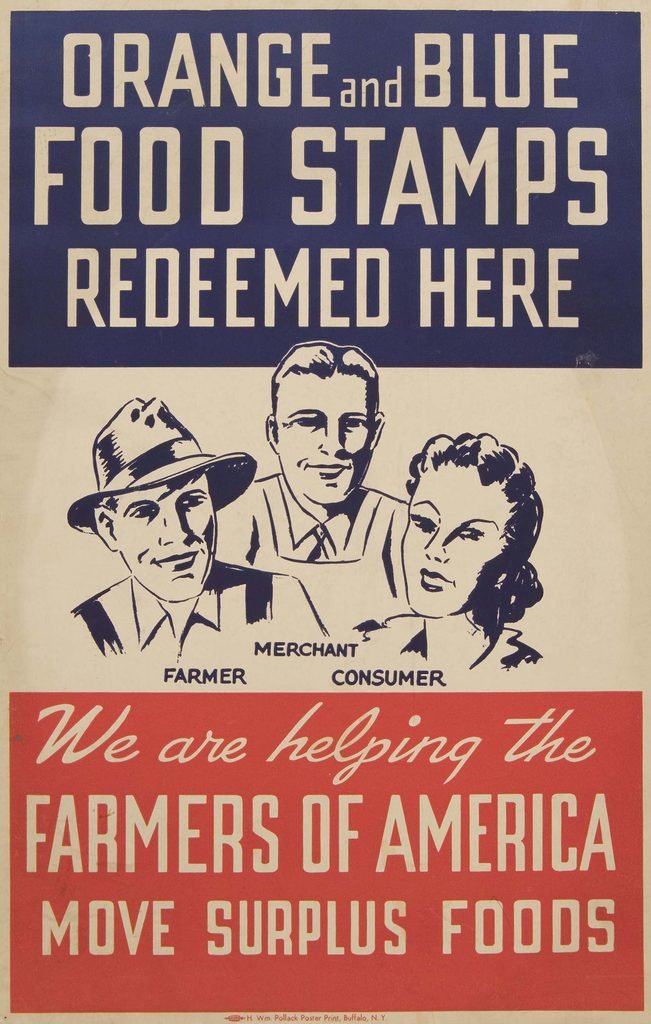
At the time, the Food Stamp Plan was a popular policy. When unemployment was at an all-time high, people who were food insecure were not necessarily blamed for their predicament; they were only “down on their luck.” This program was also popular because it supported farmers, prevented surplus crops from going to waste, and stimulated the economy during tough times.
The Food Stamp Plan ended in 1943, during World War II. Wartime demand had dramatically changed the economic conditions that had given rise to the program: unemployment had fallen and the agricultural surpluses it was designed to distribute had largely disappeared.
Food stamps were reintroduced during the Kennedy administration. In 1961, a pilot program was launched, followed by the passage of the Food Stamp Act of 1964. A new surplus of commodity crops, combined with the growing presence of television in American homes, prompted the revival of a program that had been dormant for nearly 20 years.
Documentaries like Harvest of Shame (1960) captured the lives of migrant farmworkers in the U.S., and Hunger in America (1968) helped create and bolster the narrative that hunger was a threat to be fought back against as part of America’s “War on Poverty.” Americans supported efforts to fight hunger, and food stamps were seen as a direct solution. The program sought to achieve a more effective use of agricultural overproduction, improve nutrition among low-income individuals, and strengthen the economy.
While it had a rough start during the early 1960s, the Food Stamp Act eventually gained traction. U.S. food insecurity rates reached their lowest level at the turn of the 1970s, making this program a proven federal intervention that kept people fed. During Richard Nixon’s presidency, the program grew fivefold from 3 million recipients in 1969 to 15 million by 1974. The Nixon administration also established several federal nutrition programs, including WIC, food assistance for senior citizens, and national school meal programs.
The Welfare Queen
Writer Chimamanda Ngozi Adichie once said that “stories have been used to dispossess and to malign, but stories can also be used to empower and to humanize. Stories can break the dignity of a people, but stories can also repair that broken dignity.” From mental health to tobacco use, we have seen the power a story has in fueling a narrative and ultimately changing public opinion. But sometimes that power can be dangerous. So, at a time when public consensus held that it was our government’s duty and responsibility to support the welfare of families, President Ronald Reagan undid that very opinion with one simple story that caught hold — the story of the Welfare Queen.
This narrative was based on a true story about a woman named Linda Taylor, who did, in fact, commit welfare fraud in Chicago in 1976. While a Chicago news outlet coined the term, Reagan often retold this story, with great disdain. This narrative, which was charged with racist and classist undertones, supported his effort to convince people in the U.S. to withhold taxpayer dollars from social welfare programs. What was once a war on poverty and hunger quickly became a war on what Reagan called “welfare dependency.”
The media became fixated on stories about people it portrayed as “undeserving” food stamp recipients, such as college students, able-bodied adults, and most pointedly Black single mothers who were targeted by the Welfare Queen narrative. This strategy, which began during Reagan’s campaign and continued throughout the next few decades, strengthened public support for slashing funding for social welfare programs across the spectrum, including food stamps. The Food Stamp Program saw a 15% decrease in spending in 1981, while school and summer meal programs were cut by 30%.
Funding for food stamps at the time (and still today) accounted for only 1%-2% of the entire federal budget. All of this scrutiny over such a small proportion!
Who’s Responsible?
With federal funding for food assistance significantly cut, families and individuals needed somewhere else to turn. Thus, the responsibility fell on charities, nonprofits, and faith communities to fill the gaps. In the early 1980s, the U.S. had very few players in the emergency food assistance space. Feeding America (the leading food banking system in the U.S.) had been established as Second Harvest and was growing, but most major food banks had yet to establish themselves. In Big Hunger, Andy Fisher, founder of the Community Food Security Coalition, writes that only 13 food banks existed in 1979. By 1989, there were 180 food banks — a 1,200% increase in only a decade. And that does not even include the hundreds of thousands of food pantries, soup kitchens, and other stopgap food assistance programs that multiplied across the country during that time.
With over 350 food banks now established in the U.S., it is clear that while these interventions address hunger, they do not reduce hunger over time. Rates of food insecurity do fluctuate, but they have never disappeared. Further, Feeding America maintains that for every meal provided by a charitable organization, SNAP provides nine. The charitable food system does hold a critical role, but it simply cannot keep up with the value and purchasing power of SNAP.
Picking Nits in the Food Stamp Program
Since the 1980s, food stamps (which became SNAP in 2008) have been a political punching bag, taking hits here and there. Constant scrutiny of the program to make certain that only “truly needy” individuals were using it led to seemingly never-ending changes to eligibility criteria. The Clinton administration enforced strict work requirements on the food stamp program: if you were able-bodied and enrolled, you had to show proof that you were either working or enrolled in a (nonpaying) work training program. These work requirements only reinforced the social stigma that food stamp recipients were lazy and needed to reform themselves in order to “earn” this benefit from the government.
The George W. Bush administration, in contrast, saw an overall increase in investments in SNAP. However, the work requirements remained, as did the negative public opinion about social welfare programs. And while the COVID-19 pandemic offered a bit of a reprieve from the same story, the narrative around SNAP and food assistance has by and large remained the same for the past 50 years: hungry people deserve to be hungry, and it isn’t the government’s job to feed people.
The Corporate Welfare Queens
This overly simplified, uncompassionate, and inaccurate narrative is the impetus behind H.R. 1’s treatment of SNAP. The $186 billion cut over 10 years is not the only impact: work requirements are now more restrictive (veterans, parents of children over 14, and some unhoused populations are no longer exempt), some states have implemented confusing restrictions on junk food, and the SNAP administrative cost shift to states will create a financial burden so large that they could walk away from administering SNAP entirely.
Charities are already overburdened and will not, in fact, be able to step up and provide food for the millions who will soon be ineligible for benefits. These SNAP cuts not only threaten participants, but the entire food system; because SNAP households make up 12% of retail sales, small grocers, producers, and farmers will lose millions of dollars in revenue. For those who are fighting for a better food system that works for everyone, we need a new narrative that shifts the focus from individuals to corporations.
What is the story that can change public opinion for good? The Welfare Queen was known for taking advantage of the system, so let’s reframe that and take a look at the corporate players that have done just that, to a much greater degree.
We use the term “welfare” when referring to aid provided by the government to individuals or families.
Why are we not using this term when describing corporations? The phrase “corporate welfare” points to a double standard: public assistance for families is often stigmatized, while public benefits to corporations — through tax breaks, subsidies, bailouts, and other supports — are often described in softer terms such as incentives, relief, or economic development. What are those but welfare — aid given out for their benefit?
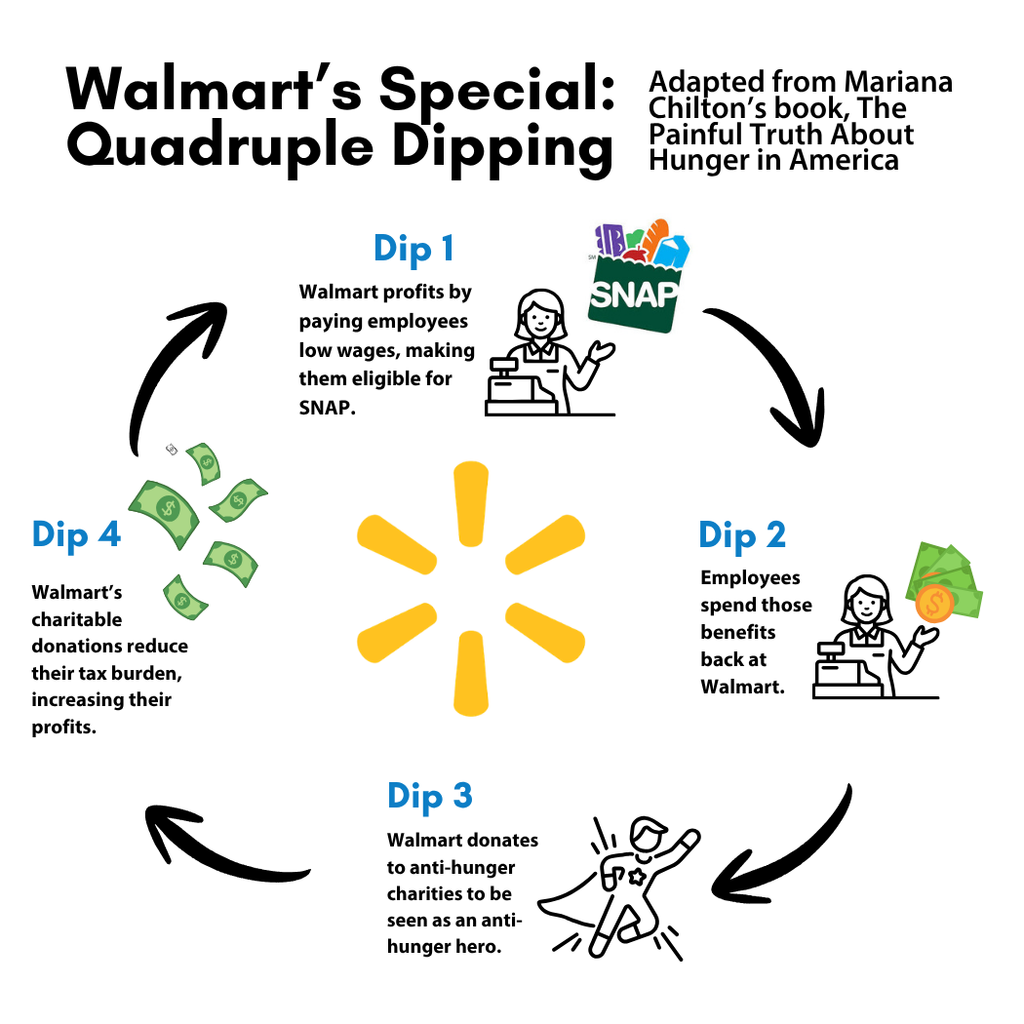
Critics often cite Walmart as an example of corporate welfare, pointing to the company’s history of receiving public subsidies and tax incentives while many of its employees have relied on public assistance to make ends meet. In her book The Painful Truth About Hunger in America, public health and food security expert Dr. Mariana Chilton aptly conveys how Walmart is the quintessential Welfare Queen, benefiting from its position in four ways.
Walmart profits by paying its employees far less than a living wage, which it can get away with because the SNAP subsidies provided by the government help make up the difference in employees’ living costs. Many of these employees then use their SNAP dollars to shop at Walmart, contributing to Walmart’s profits. Walmart also donates money and food to anti-hunger organizations, which portrays it as a charitable hero and reduces its tax burden. According to Chilton, the Walton family’s wealth has remained steady at around $200 billion, making the family’s earnings “astronomical, and their hoarding is exemplary of a pathological society that celebrates them for it.”
Walmart is not the only major corporation that takes advantage of its position in the food system. After Walmart, the next top four employers of SNAP recipients are food-adjacent corporations: McDonald’s, Dollar General, Dollar Tree, and Amazon.
According to a 2020 study by the U.S. Government Accountability Office, 70% of adults receiving SNAP, Medicaid, or both worked full-time hours each week. If these individuals are working — and are working at major companies like Walmart and McDonald’s — what is the pay gap? Back in the 1970s, the ratio of CEO to the lowest-paid employee was 20 to 1. In 2024, at Walmart and McDonald’s, the ratios were 930 to 1 and 1,014 to 1, respectively. With the discrepancy this wide within a system that prioritizes profits at the top, it becomes harder to make the case that SNAP recipients are the ones taking advantage of the system.
It’s time to shift the narrative: move the blame and shame away from individuals and onto the corporations that create and maintain conditions that are unmanageable for their employees and the food system at large.
Through H.R. 1, SNAP will lose billions of dollars during a time of economic decline. The viability of this program will be tested as states try to be more efficient in administration with fewer funds. Former SNAP participants will be left with limited options.
How much longer can corporations continue to profit from underpaying their workers while receiving tax breaks for “donating” back to the very people their wages leave hungry? And how much longer will charities be able to fill the growing gap?
There is power in a single story. Let’s start building a better one.
Justine Post, Director of the Come to the Table program, has worked at the intersection of social justice, food ministries, and local agriculture since 2016. Justine holds a Master of Social Work from UNC Chapel Hill and a Master of Divinity from Duke Divinity School.